Monday, 18 June 2007

The Spell of the Sensuous


The Spell of the Sensuous by David Abram (1996) Subtilted: Perception and Language in a More-Than-Human-World.

In his book (his only book as far as I can find out) Abram, a philospher and accomplished sleight-of-hand magician, describes the intimate relations between traditional magicians of many cultures, and the natural world which surrounds them. He then explores language and its power to 'enhance or stifle the spontaneous life of the senses.'

In the Preface he argues that 'Today we participate almost exclusively with other humans and our own human-made technologies. It is a precarious situation, given our age-old reciprocity with the many-voiced landscape. We still NEED that which is other than ourselves and our own creations.'

It is not his premise that we should renounce our modern technologies, but rather that we 'must renew our acquaintance with the sensuous world in which our techniques and technologies are rooted.'

Anyone who has lived long enough to remember a time when in our daily lives we still recognised our dependence on the natural world will be touched, and troubled, by Abram's message that 'Direct sensuous reality, in all its more-than-human mystery, remains the sole solid touchstone for an experiential world now inundated with electronically-generated vistas; only in regular contact with the tangible ground and sky can we learn how to orient and to navigate in the multiple dimensions that now claim us.'

Reading that, I was reminded of a recent survey undertaken with kids, which revealed that many of them didn't know that there was any connection between cows and milk, or that carrots grew in the earth!

Friday, 15 June 2007

Invisible Cities


From Invisible Cities (1972) by Italo Calvino:

Kublai Khan says: I do not know when you have had time to visit all the countries you describe. It seems to me you have never moved from this garden.
Marco Polo replies thus: Everything I see and do assumes meaning in a mental space where the same calm reigns as here, the same penumbra, the same silence streaked by the rustling of leaves. At the moment when I concentrate and reflect, I find myself again, always, in this garden, at this hour of evening, in your august presence, though I continue without a moments pause, moving up a river green with crocodiles or counting the barrels of salted fish being lowered into the hold.

You could consider Invisible Cities in several ways: as a series of linked stories on a single theme, or as a sort of prose poem, or even as a continuous narrative. One reviewer suggests that this book was designed to be dipped into rather than read through, also that it is perhaps not the best of Calvino’s books to start with. I was at a disadvantage on both counts. I read it straight through at 3 in the morning about two weeks ago and have been slightly troubled, indeed haunted, by it ever since.

Gore Vidal, writing in The New York Review of Books commented: "Of all tasks, describing the contents of a book is the most difficult and in the case of a marvelous invention like Invisible Cities, perfectly irrelevant."

I fear this is true, but will try nonetheless to give sufficient of a flavour to (maybe) entice some more readers to give it a go.

Invisible Cities describes imaginary conversations between Marco Polo and Kublai Khan. The Great Khan wishes to hear reports about his vast empires, which it is beyond his ability to visit himself. Marco Polo describes his visits to a series of surreal cities in the Khan's domain, each city being characterized by a unique quality or concept and each one given a name which is evocatively feminine. Cities are categorized under headings as, for example, Cities and Memory, Cities and Signs, Cities and Names, Cities and the Dead….It is for the reader (along with Kublai Khan!) to read significance into Marco Polo's fragmented tales, to puzzle over the metaphorical sense of each narrative.

The Great Khan is old and weary but still, despite his scepticism, wants the youthful Polo to enchant and amaze him with accounts of his own domains. When even the ever-inventive Polo finally tires and says that he has told him of all the cities he knows, Kublai Khan says:
“There is one city of which you never speak.”
Marco Polo bowed his head.
“Venice” the Khan said.
Marco smiled. “What else do you believe I have been talking to you about?”

When pressed to speak directly about Venice, Marco says this:
“Memory’s images are fixed in words, are erased. Perhaps I am afraid of losing Venice all at once, if I speak of it. Or perhaps, speaking of other cities, I have already lost it, little by little.”


Wednesday, 13 June 2007

The Brown House Garden - 2


Hostas enjoy the cool, north-facing Well-yard, at the back of the house - and slugs and snails are foiled by growing them in pots and chimney-pots. The Early Purple Orchids in the trough seeded themselves in and have mutiplied over the years with no human intervention.
Cardiocrinum giganteum is certainly an exotic inhabitant of The Brown House Garden. It's waxy cream trumpets give off a heady perfume which fills the Well-yard on warm summer evenings. We had one plant, a few years since, which reached 9 feet, but this year it's flowering at only about four feet. The plants die after flowering, but leave off-set bulbils which, given time, will themselves flower.

The Brown House Garden - June


Looking eastward, the wall is lower than on the other sides of the garden, where they are all about 18 feet high. Living up to her name, Maigold is a reliable May-flowerer here and goes on looking fresh and vigorous for weeks and weeks. Growing alongside is an old Rosa rugosa, skirted by catmint. All these plants do remarkably well, considering the amount of shade they get in the morning from a vast sycamore.

Here is Echium pininana 'Pink Fountain', also known as Tower of Jewels and Pride of Teneriffe. This was its first flowering here, after succumbing to winter weather for several years. A real show-stopper for visitors to the garden this year!

Earlier in the season, when it became clear that the echium really was, finally, going to flower, Tim explained some of its botanical properties to Sam, who was most interested.

Sunday, 3 June 2007

Holiday Reading 4: William Sansom

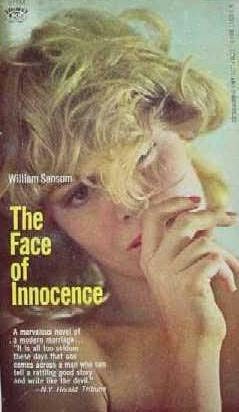
In 1951 Graham Greene’s lover and muse, Catherine Walston, gave him a copy of The Face of Innocence by William Sansom (1912 –1976) "because there is nothing else to give you". Not sure what to make of that remark. Sansom is a writer whom I’d not come across before, and so picking this book up at random I had no idea what to expect. Later, I discovered that there is very little about him on the Internet, although in his day he was highly regarded by other writers such as Eudora Welty, Henry Green and Graham Greene himself. I think he’s what it described as ‘a writers’ writer’, with a very conscious use of language, sometimes a little too clever and self-regarding, which can be a distraction to the reader. His obvious enjoyment of language leads him sometimes to make up his own verbs, which makes him quite fun to read.

The plot revolves round the relationship of two men with a woman called, portentously, Eve. She marries and deceives one of them, while using the other one, who is infatuated with her, as her confident. The big question implied in the ironical title is: whose is the face of innocence? Not Eve, surely, who is highly manipulative and whose motives ultimately remain dark. In fact, her character, central to the whole narrative, is problematical – I was never really convinced by her.

During World War II, Sansom, like Henry Green, was a fireman with the National Fire Service, combatting infernos created by German bombing attacks on England – in fact he may have been a colleague in the service. This experience became one of the major themes of his early works, such as Fireman Flower, and Other Stories. His descriptions of London and London life, in novels and stories set there, became one of the hallmarks of his work.

There’s a good review here:
http://myweb.tiscali.co.uk/christopherpriest/sanrev.htm


Saturday, 2 June 2007

Holiday Reading 3: Heinrich Herrer.


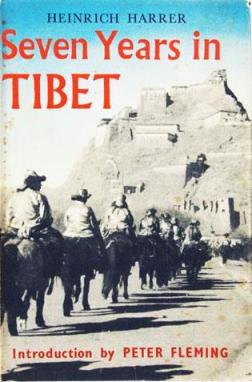
Seven Years In Tibet by Heinrich Harrer is a fascinating read.
(There's a 1997 film which received mixed reviews. ) The book tells the story of how Austrians Heinrich Harrer and Peter Aufschnaiter were imprisoned as enemy aliens by the British while part of a German expedition to Nanga Parat in the Himalayas, in present-day Pakistan, in summer 1939. Harrer and Aufschnaiter escaped and made it across the border into Tibet in 1944, crossing the treacherous high plateau, surviving conditions of the utmost severity. Shortly after arriving in Tibet, they were ordered to return to India but were able to disguise themselves, and make their way to Lhasa. Harrer became a tutor and close friend of the Dalai Lama, who was then still a boy of fourteen. The first part of the book, recounting the perilous journey across Tibet, is an adventure story to thrill any would-be explorer, while Harrer's observation of Lhasa at that time, seen from his Westerner's viewpoint, is a unique record of life in the Forbidden City before the Chinese Communist invasion of 1950.
For an excellent review of the book see http://theopencritic.com/?p=3
Harrer, who remained friends with the Dalai Lama for the rest of his life, died aged 93 in 2006.
For a succinct account of Harrer's life, see the Guardian obituary:

Holiday Reading 2:Rumer Godden

Why, I wondered, had I never read Kingfishers Catch Fire? Still it was good to have such a treat in reserve. The other books of Godden's which I've read - and she wrote 60 all told - are The River and Black Narcissus, both of which were made into films. (I saw the latter when it came out in 1947, when I was ten years old - taken to the cinema by my father - and can remember the colours and atmosphere of it to this day.)
Kingfishers Catch Fire, published in 1953, is a fictionalised acount of the period she spent living frugally in a cottage in Kashmir; she depicts herself as a free spirit who for various reasons is hard up, but in real life she was grimly trying to write to earn money in order to repay the debts which accrued in the collapse of her marriage.

The story gives a convincing picture of the way of life and characters of a particular place and time, without in any way glamourising them or presenting an 'idyll' - although only a Kashmiri would be able to tell us how 'true' it is!

During her time in Kashmir, as well as writing books, Godden set up, and taught in, a school and practised herbal medicine. The family survived an apparent poisoning attempt by two servants, all of which is incorporated into the novel.