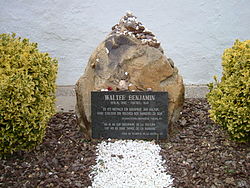
Sunday, 30 December 2007

A Suitcase

From Nobody’s Home
Essays by Dubravka Ugresic

A Suitcase
‘There are authors who have penned marvellous pages on exile. They unwittingly polish the subject, and in doing so give exile the glow of a romantic rebellion against the demands of everyday life, a rejection of home and homeland for the thrill of personal freedom. The people who have written these pages overlook the banalities; Walter Benjamin killed himself because he wasn't able to get his papers stamped; everything might have turned out differently had that anonymous clerk stamped Benjamin's passport. But in myths, including ones about exile, everyone is inclined to forget the anonymous bureaucrats. And this is how the bold face of clerkish triviality, shored up by both the author’s, and the reader's, romantic expectations, becomes the face of cruel Destiny.’

‘Literature tends to show the romantic side of exile. In reality, people live in exile submerged in trauma. The image of exile suggests a rebellious fragmentation, but also a servile obedience to the process of acquiring a new home. The only way those in exile are able to leave it behind is not to leave it behind at all, but to live it as a permanent state, to turn their waiting room into a cheery ideology of life, and to embrace the schizophrenia of exile as the norm of normalcy, revering only one god: the suitcase!’

‘The most intimate side of exile is tied to luggage. As I write these lines I am surrounded by a dozen kinds: bags, suitcases (with and without wheels), costly valises, cheap duffels, all purchased in various cities. I look at them fondly: they are my only true companions, witnesses to my wanderings. The suitcases travel, go across borders, move in and move out with me……..’

Saturday, 8 December 2007

Gorse

'When gorse be out of bloom, love be out of season.' Cornish folk saying.

Gorse in bloom on Maryport Sea Brows 6th December 2007

Thursday, 29 November 2007

Raymond Roussel and the Republic of Dreams

Raymond Roussel (1877–1933)

Raymond Roussel and the Republic of Dreams by Mark Ford.

French poet, novelist, playwright, musician, chess-player, neurasthenic and drug addict. In addition, he was immensely wealthy, although most of his wealth was dissipated in trying to bring attention to his writing.

Little known today, yet Roussel's novels, poems and plays profoundly influenced certain groups within C20th French literature, including the Surrealists and Oulipo. In the 1950s his work excited the interest of young American poets such as John Ashbery (who had lived in Paris for over five years where he was known as ‘that crazy American who’s interested in Roussel') and Kenneth Koch. His influence is apparent in some of the poems of Ashbery and Koch written in the mid-1950s. In the 1970s I was using one of Koch's books, Rose, Where did You get that Rose, while teaching English to 'less able' adolescents. It was a gift to a teacher and a winner with the kids every time. Now I understand better how Koch came to write in the way that he did.

Ashbery has written the Introduction to Mark Ford’s book, outlining the processes by which Roussel’s work became more widely known in the 1960s. Michel Foucault’s first book, published in 1963, was a study of Roussel. Alain Robbe Grillet and Michel Butor, creators of the nouvel roman, acknowledged their debt to him.

The following quotes on the subject of Raymond Roussel will give some indication of his standing and influence among his contemporaries and some who came later:

"A formidable poetic apparatus" -Marcel Proust


"Raymond Roussel belongs to the most important French literature of the beginning of the century" -Alain Robbe-Grillet


"Genius in its pure state" - Jean Cocteau


"Creator of authentic myths - Michel Leiris


"A great poet" - Marcel Duchamp


"The President of the Republic of Dreams" - Louis Aragon


"The greatest mesmerist of modern times" - André Breton


"The plays are among the strangest and most enchanting in modern literature"- John Ashbery


"My fame will outshine that of Victor Hugo or Napoleon"- Raymond Roussel

The only words written by Roussel that I have read are those quoted in Mark Ford's book but I was so intrigued by him that I'm inspired to track some of his books down to read. There's plenty of information about Roussel on Websites, for example:

http://www.centerforbookculture.org/context/no10/winkfield.html

http://en.wikipedia.org/wiki/Raymond_Roussel

Tuesday, 25 September 2007

Going Down South

On a trip down to Cheshire, to talk to Cranford Quilters, I found I was staying overnight within spitting distance of the famous Jodrell Bank observatory. It makes an excitingly space-age impact as it looms out of the autumnal landscape, at first appearing strange and obtrusive. But after a few hours, walking in the surrounding lanes, viewing it from different angles, it acquires a mysterious elegance and, eventually, comes to seem a completely appropriate part of the scene.

This part of rural Cheshire is very much Manchester commuting country - going on foot in the lanes is hazardous as high-spec cars race along at speed bearing the well-heeled business persons home to their newly-built country mansions.

But not all the local residents are like this: I was staying with people who live in an eighteenth century farmhouse with surrounding fields which are run as a smalholding - they produce all their own meat (from pigs, lambs, a few beef cattle) fruit and vegetables. Being offered this sort of food reminds me of what we miss most of the time, unless we go to a local farmers' market.

Cranford Quilters is a very friendly and active group and we had a stimulating evening, with some good Show and Tell and me giving my Islamic Arts and Crafts talk and showing quilts inspired by the Moorish patterns I'm so fascinated by. Altogether, despite the hair-raising drive down the M6 - unrelenting torrential rain, bumper-to-bumper commercial traffic, road works causing tail-backs three miles long - I had a great time and felt that the visit more than justified the journey. Anyway, by contrast, the return drive was a doddle, with the Motorway behaving as it should in fine, dry conditions.

Friday, 21 September 2007

Francis Ponge (1899-1988)

Francis Ponge French essayist/poet, who often combined the two forms to create a sort of prose poetry.

Quoting from Wikipaedia:
‘In his most famous work, Le parti pris des choses (Often translated The Voice of Things), he meticulously described common things such as oranges, potatoes and cigarettes in a poetic voice, but with a personal style and paragraph form (prose poem) much like an essay. These poems owe much to the work of the French Renaissance poet Remy Belleau. Ponge avoided appeals to emotion and symbolism, and instead sought to minutely recreate the world of experience of everyday objects. His work is often associated with the philosophy of Phenomenology.
He described his own works as "a description-definition-literary artwork" which avoided both the drabness of a dictionary and the inadequacy of poetry.’

Only one of his works could be discovered on the shelves here: Le Grand Recueil (subtitle Pieces). It is the original Gallimard edition of 1961 and has a soft, foxed paper cover. It is printed on equally soft, thick pages, some of which remain uncut. Sorry to say, my rusty French is no longer up to translating without recourse to a dictionary. Even worse, the On-line French dictionary claims that many of the words in the following ‘Symphonie Pastorale’ do not exist!

Symphonie Pastorale
Aux deux tiers de la hauteur du volet gauche de la fenetre, un nid de chants d’oiseaux, une pelote de cris d’oiseaux, une pelote de pepiments, une glande gargouillante cridoisogene,
Tandis qu’un lamellibranche la barre en tracers,
(Le tout envelope du floconnement adipeux d’un ciel nuageux)
Et que la borborygme des crapauds fait le bruit des entrailles,
Le coucou bat regulierement comme le bruit du coeur dans le lointoin.

Fortunately, http://www.kalin.lm.com/ponge.html has some examples of Ponge’s writings in translation:

Rhetoric
I assume we are talking about saving a few young men from suicide. I have in mind those who commit suicide out of disgust, because they find that others own too large a share of them. To them one should say: at least let the minority within you have the right to speak. Be poets. They will answer: but it is especially there, it is always there that I feel others within me; when I try to express myself, I am unable to do so. Words are readymade and express themselves: they do not express me. Once again I find myself suffocating. At that moment, teaching the art of resisting words becomes useful, the art of saying only what one wants to say, the art of doing them violence, of forcing them to submit. In short... Found a rhetoric, or rather, teach everyone the art of founding his own rhetoric. This saves those few, those rare individuals who must be saved: those who are aware, and who are troubled and disgusted by the others within the, those individuals who make the mind progress, and who are, strictly speaking, capable of changing the reality of things.

the pleasures of the door
Kings do not touch doors.
They do not know that happiness: to push before them with kindness or rudeness one of these great familiar panels, to turn around towards it to put it back in place - to hold it in one's arms.
... The happiness of grabbing by the porcelain knot of its belly one of these huge single obstacles; this quick grappling by which, for a moment, progress is hindered, as the eye opens and the entire body fits into its new environment.
With a friendly hand he holds it a while longer before pushing it back decidedly thus shutting himself in - of which, he, by the click of the powerful and well-oiled spring, is pleasantly assured.

On the above website I also find some words of Ponge translated by Peter Riley. http://www.kalin.lm.com/water.html

Friday, 14 September 2007

The Poetry of William Bronk (1918 - 1999)


Some stanzas from The Force of Desire by William Bronk. (1979)
The slow, slow light in the winter sky
this very early morning assures us the world
is not the actual world. Never was.

The longing for God, in its intensity,
shares and suggests the power and intensity
of God's longing. And it is - but not for us.

The morning door is open to the outer world;
the pleasure of edges, clear shapes and names.
Its air is the sharp pain of your seperateness.

In human nature we look not for ourselves
But for what is there. We may be a clue
Though it is not certain. We know about false leads.

Truth has many forms which are not its form
if it has one. What has a form of its own
or, having, is only it? There is truth.

If our day-lives mattered at all, no
matter that we dream; but they don’t and the dream
is the life as if it mattered, as we dream it may.

There are some writings about Bronk's poetry here:
http://www.english.uiuc.edu/maps/poets/a_f/bronk/poetry.htm

Saturday, 1 September 2007

Vol.I The Unknown Matisse/ Vol II Matisse. The Master.


The Unknown Matisse, Volume I of Hilary Spurling's biography covers his early years, from his birth in 1869 to 1908. When it was published in 1998, fellow biographer Michael Holroyd declared that she had done for Matisse 'what George Painter famously did for Proust in the 1950s.' The comprehensive way in which Spurling places Matisse in the context of his contemporaries makes this a book for art historians as much as for the general reader. Despite that, it's also a real 'page-turner', since the story of his life is told in such a lively and engaging manner that it's very hard to put down.
Matisse. The Master,Volume II, describes his life once he became recognised. It is significant that the book is dedicated to Matisse's wife, Amélie, whose own life would make a fascinating study for its own sake. She was his mainstay and helpmeet through the early years of struggle and poverty; once he became famous, and affluent, her role was taken over by others and she went into the sort of 'decline' in which she was constantly ill with unspecified problems - very reminiscent of what happened to, say, Alice James, the sister of the more famous Henry and William. It was not an uncommon fate for gifted and intelligent women in the C19 who could find way to break outof the stereotypical view of their roles in life as wives, mothers or, as often was the case, spinsterhood which trapped them in the parental home as carers.