Saturday, 15 March 2008

Blue Hills, or the Romantic Myth

Sometimes hills really ARE blue. These are not remembered, they're seen every day. You can even make a long journey to the other side of the Solway Firth to actually visit them, the hills of Dumfries and Galloway. Of course, if you travel to these distant hills, when you get there they don't look blue and there is nothing romantic about them. They are grey and rocky, covered in sheep and heather. But you can climb them, pant and sweat to the top-most cairn, stand and take in the panoramic view, echelons of hills and ranges stretching away endlessly to the west. Or turn to the east, and look back across the Firth to where you've come from, the blue and misty Lakeland fells standing sentinel on the horizon, mysterious and unattainable......So, where does that leave memory and imagination?

Thursday, 13 March 2008

The Primrose Path

Despite the recent storms and gales, I found primroses in bloom in Flimby woods today. That's early, for Cumbria. In my Cornish homeland, of course, they'll have been out in profusion for weeks now. These Northern plants are less prolific, more reticent, discreetly hiding beside the deepest, darkest paths, seen only by deer and rabbits - and by those who go searching for them. These sparse, hidden clumps are the modest evokers of all the springs I remember, primroses shining out from dark hollows, lining the edges of fields, carpeting the banks of streams. In the North, one learns to value such small living tokens of one's past.

Thursday, 14 February 2008

'The Idea of North' - Glenn Gould


From "The Idea of North": an Introduction

‘When I went to the North, I had no intention of writing about or of referring to it even parenthetically in anything that I wrote. And yet, almost despite myself, I began to draw all sorts of metaphorical allusions based on what was really a very limited knowledge of the country and a very casual exposure to it. I found myself writing musical critiques, for instance, in which the - the idea of the North - began to serve as a foil for other ideas and values that seemed to me depressingly urban oriented and spiritually limited thereby.’

‘Admittedly, it's a question of attitude, and I'm not sure that my own quasiallegorical attitude towards the North is the proper way to make use of it or even an accurate way in which to define it. Nevertheless, I'm by no means alone in this reaction to the North; there are very few people who make contact with it and emerge entirely unscathed. Something really does happen to most people who go into the North - they become at least aware of the creative opportunity which the physical fact of the country represents and - quite often, I think - come to measure their own work and life against that rather staggering creative possibility: they become, in effect, philosophers. ‘

Thursday, 3 January 2008

Samuel Beckett on Proust (1931)

"There is no escape from yesterday because yesterday has deformed us, or been deformed by us. The word is of no importance. Deformation has taken place. Yesterday is not a milestone which has been passed, but a daystone on the beaten track of the years, and irremediably part of us, within us, heavy and dangerous. We are not merely more weary because of yesterday, we are other, no longer what we were before the calamity of yesterday." (P13)

"The aspirations of yesterday were valid for yesterday's ego, not for today's. We are disappointed at the nullity of what we were pleased to call attainment. But what is attainment? The identification of the subject with the object of his desire. The subject has died - and perhaps many times - on the way. (P13f)

"Voluntary memory (Proust repeats it ad nauseam) is of no value as an instrument of evocation, and provides an image as far removed from the real as the myth of our imagination or the caricature furnished by direct perception. There is only one real impression and one adequate mode of evocation. Over neither have we the least control." (P14)

"But involuntary memory is an unruly magician and will not be importuned. It chooses its own time and place for the performance of its miracle. I do not know how many times this miracle recurs in Proust. I think twelve or thirteen times. But the first - the famous episode of the madeleine steeped in tea - would justify the assertion that his entire book is a monument to involuntary memory and the epic of its action. The whole of Proust's world comes out of a teacup....."(P34)

On Page 54, quoting Proust: 'How can we have the courage to wish to live, how can we make a movement to preserve ourselves from death, in a world where love is provoked by a lie and consists solely in the need of having one's suffering appeased by whatever being has made us suffer.?' (Proust, of course, is at this point dwelling on his painful and labyrinthine relationship with Albertine.)

Beckett comments: "Surely in the whole of literature there is no study of that desert of loneliness and recrimination that men call love posed and developed with such diabolical unscurpulousness." On Page 64, quoting Proust: 'One lies all one's life long, and above all to that stranger whose contempt would cause the most pain - oneself.'

Sunday, 30 December 2007

A Suitcase

From Nobody’s Home
Essays by Dubravka Ugresic

A Suitcase
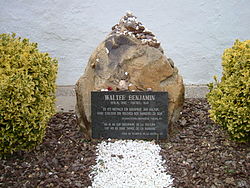
‘There are authors who have penned marvellous pages on exile. They unwittingly polish the subject, and in doing so give exile the glow of a romantic rebellion against the demands of everyday life, a rejection of home and homeland for the thrill of personal freedom. The people who have written these pages overlook the banalities; Walter Benjamin killed himself because he wasn't able to get his papers stamped; everything might have turned out differently had that anonymous clerk stamped Benjamin's passport. But in myths, including ones about exile, everyone is inclined to forget the anonymous bureaucrats. And this is how the bold face of clerkish triviality, shored up by both the author’s, and the reader's, romantic expectations, becomes the face of cruel Destiny.’

‘Literature tends to show the romantic side of exile. In reality, people live in exile submerged in trauma. The image of exile suggests a rebellious fragmentation, but also a servile obedience to the process of acquiring a new home. The only way those in exile are able to leave it behind is not to leave it behind at all, but to live it as a permanent state, to turn their waiting room into a cheery ideology of life, and to embrace the schizophrenia of exile as the norm of normalcy, revering only one god: the suitcase!’

‘The most intimate side of exile is tied to luggage. As I write these lines I am surrounded by a dozen kinds: bags, suitcases (with and without wheels), costly valises, cheap duffels, all purchased in various cities. I look at them fondly: they are my only true companions, witnesses to my wanderings. The suitcases travel, go across borders, move in and move out with me……..’

Saturday, 8 December 2007

Gorse

'When gorse be out of bloom, love be out of season.' Cornish folk saying.

Gorse in bloom on Maryport Sea Brows 6th December 2007

Thursday, 29 November 2007

Raymond Roussel and the Republic of Dreams

Raymond Roussel (1877–1933)

Raymond Roussel and the Republic of Dreams by Mark Ford.

French poet, novelist, playwright, musician, chess-player, neurasthenic and drug addict. In addition, he was immensely wealthy, although most of his wealth was dissipated in trying to bring attention to his writing.

Little known today, yet Roussel's novels, poems and plays profoundly influenced certain groups within C20th French literature, including the Surrealists and Oulipo. In the 1950s his work excited the interest of young American poets such as John Ashbery (who had lived in Paris for over five years where he was known as ‘that crazy American who’s interested in Roussel') and Kenneth Koch. His influence is apparent in some of the poems of Ashbery and Koch written in the mid-1950s. In the 1970s I was using one of Koch's books, Rose, Where did You get that Rose, while teaching English to 'less able' adolescents. It was a gift to a teacher and a winner with the kids every time. Now I understand better how Koch came to write in the way that he did.

Ashbery has written the Introduction to Mark Ford’s book, outlining the processes by which Roussel’s work became more widely known in the 1960s. Michel Foucault’s first book, published in 1963, was a study of Roussel. Alain Robbe Grillet and Michel Butor, creators of the nouvel roman, acknowledged their debt to him.

The following quotes on the subject of Raymond Roussel will give some indication of his standing and influence among his contemporaries and some who came later:

"A formidable poetic apparatus" -Marcel Proust


"Raymond Roussel belongs to the most important French literature of the beginning of the century" -Alain Robbe-Grillet


"Genius in its pure state" - Jean Cocteau


"Creator of authentic myths - Michel Leiris


"A great poet" - Marcel Duchamp


"The President of the Republic of Dreams" - Louis Aragon


"The greatest mesmerist of modern times" - André Breton


"The plays are among the strangest and most enchanting in modern literature"- John Ashbery


"My fame will outshine that of Victor Hugo or Napoleon"- Raymond Roussel

The only words written by Roussel that I have read are those quoted in Mark Ford's book but I was so intrigued by him that I'm inspired to track some of his books down to read. There's plenty of information about Roussel on Websites, for example:

http://www.centerforbookculture.org/context/no10/winkfield.html

http://en.wikipedia.org/wiki/Raymond_Roussel