Monday, 26 March 2007

The Akhmatova Journals


The Akhmatova Journals by Lydia Chukovskya
Lydia Chokovskya, Akhmatova's close friend, kept intimate diaries of her life and conversations with her. First published in Russia in 1987, this intimate insight into the daily life and sufferings of Akhmatova, as well as of those around her, is ' illuminating both of horror and of genius. '

The book ends with a long section containing poems by Akhmatova, those without which, as Chukovskya says, 'my entries would be hard to understand.'

The Cellar of Memory
But it's arrant nonsense that I live in sadness
And that remembrance nags at me.
Not often am I guest of memory,
And it always leaves me confused.
When I go down with a lantern to the cellar
It seems to me once more a landslip
Thunders down the narrow stairway after me.
The lantern smokes, I cannot now return,
But I know I go there to the enemy.
And I pray as if for mercy.....But there
It's dark and quiet. My feast day has come to an end!
Thirty years have gone since bidding the ladies farewell,
That joker is dead from old age.....
I have come too late. As if it matters!
I may not show myself anywhere,
But on the walls I touch the paintings
And by the fire I warm myself. Is that not a miracle?
Through this mould, these fumes, this dust
Two sparkling emeralds flashed,
And a cat mewed. Well, let's go home!

But where is my home, and where my reason?

Remembering Anna Akhmatova


Remembering Anna Akhmatova by Anatoly Nayman.
(Cover illustration shows a drawing by Modigliani)


Billo asked me some time ago to tell him some books about Akhmatova.
This is one by someone who knew her intimately in the last years of her life.
Akhmatova's life was tragic. During Stalin's years of terror she had seen her husband and son taken away to prison camps, suffered the disappearance of many friends, and had lived in cultural isolation and utter deprivation.

Anatoly Nayman was Akhmatova's literary secretary and disciple during her last years and he recalls here their conversations about literature and friends, anecdotes about family life and vignettes, some amusing, some ordinary and some tragic: Joseph Brodsky digging a fall-out shelter for her to her utter bemusement; Akhmatova's bravery in intervening with the authorities on behalf of Brodsky....
Throughout the book, the narrative of conversations and events is illustrated by quotations from poems by Akhmatova and others. This is one of her poems which Nayman quotes. It was written about a bouquet of roses given to her by a friend:

No doubt you're someone's spouse and also someone's lover
My casket's themes suffice without including you,
All day I've been entreated by the flute celestial
To make a gift of words as partners for her sounds.
And you were not the object which seduced my gaze.
So many avenues the night extends before me,
So many sad chrisanthmums September gives.

In his Foreword to Nayman's book (1991), Isaiah Berlin writes:
Anna Andreevna Akhmatova, a noble and most moving writer, is one of the four great poets whose art dominated and continues to dominate Russian literature; her genius and monstrous persecution by the state will be remembered as long as the history and literature of Russia continue to be known.

Sunday, 25 March 2007

The Aged Beast Takes a Sunday Stroll


A Sunday stroll on a fine Spring morning. Low tide. Blue haze of sky and sea. Skylarks larking and calling above

Friday, 23 March 2007

The Translation of Memories

Recollections of the Young Proust from the letters of Marie Nordlinger

This book, by P.F. Prestwich, records the friendship between Marie Nordlinger, the English cousin of the musician and composer Reynaldo Hahn, Hahn himself and Marcel Proust. The three young people (all in their early 20s) met in Paris when Marie went there to study art. It was to prove a life-long friendship, extending over almost thirty years and ending only with Proust's death in 1922. The friendship between the two cousins endured until Hahn's death in 1947.

Prestwich worked with Marie Nordlinger for some years transcribing the correspondence between Marie, Proust and Hahn. She became a close friend of the Nordlinger family and was the inheritor of Marie's archive of letters and other memorabilia.

Although Proust and Nordlinger were drawn together by their shared appreciation of fine arts, cathedrals and the countryside, the mainspring of their friendship was their shared devotion to Reynaldo Hahn, with whom both were, and remained, passionately in love.

Nordlinger was one of the first of Proust's circle to publish some of the letters she received from him - forty one of them are included in Lettres á une amie (Editions du Calame, Manchester, 1942). They contain an Introduction by her giving a brief account of her collaboration with Proust on the translation of two of Ruskin's books, The Bible of Amiens and Sesame and Lilies.


Prestwich's book throws fascinating sidelight on the three characters during all the years they knew and corresponded with each other. Nordlinger herself is worth studying - the talented, artistic daughter of the typically liberal, hard-working Victorian middle class living in Manchester at that time achieved recognition as an artist and sculptor. She also became the agent for a wealthy American collector who gave her carte blanche to travel around in America buying and selling on his account, only marrying when she was 35.

The book gives a wonderfully clear and intimate insight into Proust's work and pre-occupations during the years before he finally published Á La Recherche, as also of Hahn's development as the eminent composer and conductor he eventually became.

Tuesday, 20 March 2007

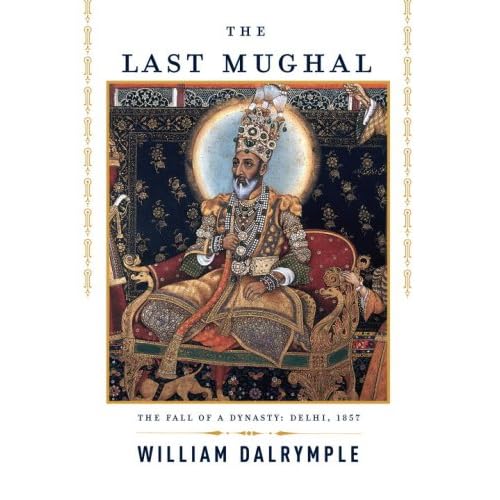
The Last Moghul by William Dalrymple


In an interview Dalrymple says this: The narrative revolves particularly around the last Moghul emperor Bahadur Shah Zafar who creates this wonderful renaissance at the very end of Moghul rule, and who lived to his old age to see that destroyed when the Indians rose up in mutiny against the British and were crushed horribly, in what remains one of the great unwritten genocides of the British Empire. People are aware now of the destruction of the Aborigine peoples of Australia and Tasmania, the Irish potato famine is well documented; this is an imperial horror story of a similar scale, when the British surround and destroy Delhi. It’s never been written up completely for example how the British track down, hunt and kill every last Moghul prince they can find.

Dalrymple's research for this book was as thorough and meticulous as we would expect of him. What was amazing was to learn that he and his colleagues found the Persian and Urdu documents relating to Delhi in 1857, known as The Mutiny Papers and housed in the National Archive of India in New Delhi, virtually unused. He describes his discovery of this treasure as one of the highlights of the whole project. What he describs as 'the street-level' nature of some of the material enables him to layer his narrative, giving it a totally convincing graphic quality that conventional histories miss. We get 'the larger picture', the political, religious and military forces at work, as well as detailed accounts of the way in which these were experienced by innumerable individuals, members of Zafar's family and court as well as the commmon citizens of Delhi.

Irfan Husain, a Pakistani commentator, in an article in Khaleej Times Online says:
As so brilliantly chronicled by William Dalrymple in ‘The Last Moghul’, the British exiled the King and killed his heirs, thus ending the dynasty started by Babur over three centuries ago. To be accurate, the line had been in a state of decline for years, and the Uprising was the last nail in its coffin.

Husain goes on to explain that it was Dalrymples' book which encouraged him to search Karachi's Sindh archives and find there yet more records of the fall-out from the Mutiny - that, for example, some of the exiled prisoners from Delhi were transported from Karachi to the Andaman Islands. The whole article is here: http://www.khaleejtimes.com/ColumnistHomeNew.asp?xfile=data/irfanhusain/2007/January/columnistirfanhusain_January1.xml§ion=irfanhusain&col=yes

Dalrymple ends the book by tracing the 'fall-out' from the destruction of the Mughals' 'peaceful and tolerant attitude to life', regretting what he sees as 'the bleak dualism' of today's confrontations beween nations, ideologies and religions. There is, he says, '..much to regret in the way that the British swept away and rooted out the late Mughals' pluralistic and philosophically composite civilisation.'

Friday, 16 March 2007

Proust in the Power of Photography by Brassai


This brilliant little book by the photographer Brassai is a fascinating study of the importance in Proust's life and writing of photography; Proust was an avid collector of photographs of his friends and social acquaintances, sometimes to the point of obsession.
Brassai (Gyula Halász) himself was born in Transylvania and after moving to France learned the language through reading Proust. He writes:
'In his battle against Time, that enemy of our precarious existence, ever on the offensive though never openly so, it was in photography, also born of an age-old longing to halt the moment, to wrest it from the flux of 'dureé' in order to 'fix' it forever in a semblance of eternity, that Proust found his best ally.'
The epigraph at the begining of Brassai's book is a quote from A L'Ombre des Jeunes Filles en Fleures:
'Pleasures are like photographs: those taken in the beloved's presence no more than negatives, to be developed later, once you are at home, having regained the use of that interior darkroom, access to which is 'condemned' as long as you are seeing other people.'
C/f Wordsworth:
And when upon my couch I lie
In vacant or in pensive mood
They flash upon that inward eye
Which is the bliss of solitude.

Tuesday, 13 March 2007

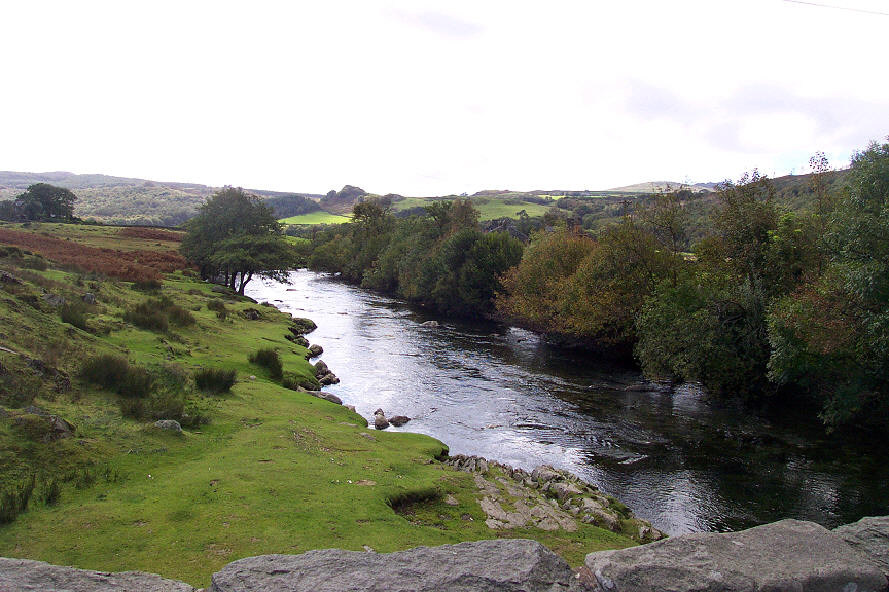
Wordsworth's River Duddon

I offer this 'Thought' to all who write, or make, or aspire to do either:


‘Enough, if something from our hands have power
To live, and act and serve the future hour;
And if, as toward the silent tomb we go
Through love, through hope and faith’s transcendent dower,
We feel that we are greater than we know.’
Wordsworth: The River Duddon. Afterthought